
Basic Static Serving
The router.static() method serves files from a folder under a URL prefix, with caching, byte ranges, and path safety built in. It covers HTML, CSS, JavaScript, images, fonts, and any other asset on disk.
Basic Usage
Mount a folder under a URL prefix:
import { Router } from '@neabyte/deserve'

const router = new Router()

// Serve ./public under the /static prefix
router.static('/static', {
  path: './public',
  etag: true,
  cacheControl: 86400
})

await router.serve(8000)
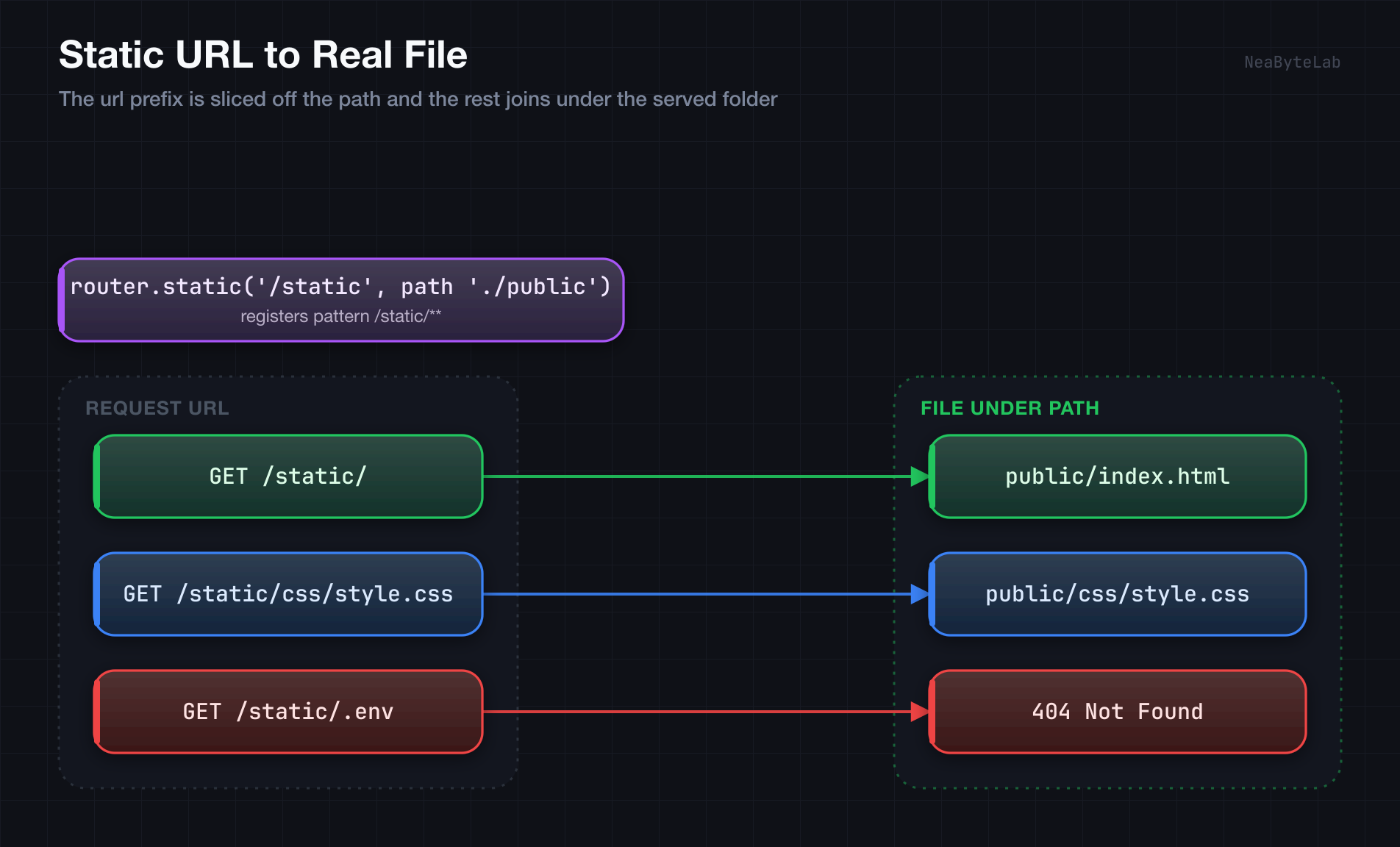
That mount maps each URL under /static to a file in public/:
GET /static/index.htmlservespublic/index.htmlGET /static/css/style.cssservespublic/css/style.cssGET /static/.envis rejected with 404 before any read
How It Works
A static mount is not a file route. It is a separate registry that the router checks only after dynamic routes miss, so the matching order is fixed:
- Entry middleware runs first.
- A matching dynamic route handles the request and static never runs.
- When the path matches a route under a different method, the router replies 405 Method Not Allowed with an
Allowheader, and static still never runs. - With no route match at all, the router walks the static mounts and serves the first one whose prefix covers the path.
A request keeps its prefix until a mount matches, then the prefix is stripped and the remainder becomes the file path under the folder. So GET /static/css/style.css strips /static and resolves css/style.css inside public/.
Prefix Matching
Mounts are sorted longest prefix first, so the most specific one wins. A mount on /admin/assets is tried before a mount on /admin, which lets a broad fallback and a focused folder live together. A mount on / acts as a catch-all that covers every remaining path. Multiple mounts and their dispatch order live in Multiple Directories.
Supported Methods
A static mount answers GET and HEAD only. Any other method on a path the mount covers returns 405 Method Not Allowed with Allow: GET, HEAD. A HEAD request runs the same path as GET and returns the headers with an empty body.
Static File Options
The second argument is a ServeOptions object. Only path is required:
path
The filesystem directory to serve from, relative to the current working directory or absolute. An empty path throws at mount time:
router.static('/static', {
  path: './public' // Serve files from public folder
})

router.static('/assets', {
  path: '/absolute/path/to/assets' // Absolute path also works
})
etag
Turns on ETag generation, and it defaults to on when omitted. The tag is a weak validator built from a SHA-256 hash of the file size and modification time, not the file contents, so it stays cheap to compute:
router.static('/static', {
  path: './public',
  etag: true // Build ETag from size and mtime
})
When a client sends a matching If-None-Match, the response is 304 Not Modified with no body. A client sending If-Modified-Since gets the same 304 when the file is no newer than that date.
cacheControl
Sets the Cache-Control max-age in seconds, sent as public, max-age=<seconds>. It applies only when the value is 0 or higher, and is omitted otherwise:
router.static('/static', {
  path: './public',
  cacheControl: 86400 // Cache for one day
})

router.static('/assets', {
  path: './assets',
  cacheControl: 31536000 // Cache for one year
})
Custom Handler
In place of options, static() accepts a function of the shape (ctx, urlPath) => Response. It receives the context and the path with the mount prefix already stripped, which suits an in-memory asset map or a generated file:
// Serve assets from a map by stripped path
router.static('/cdn', (ctx: Context, urlPath: string) => {
  const assets: Record<string, string> = { 'logo.svg': '<svg></svg>' }
  const body = assets[urlPath]
  if (body === undefined) {
    return ctx.send.empty(404)
  }
  return ctx.send.custom(body, { headers: { 'Content-Type': 'image/svg+xml' } })
})
Byte-Range Requests
Static responses support a single byte range so a client can fetch part of a file, which is what a video scrubber or a resumable download relies on. Every static response advertises Accept-Ranges: bytes:
- A single valid range returns 206 Partial Content with
Content-Range: bytes start-end/size, streaming only those bytes off disk. - A range past the file size returns 416 Range Not Satisfiable with
Content-Range: bytes */size. - An absent, multi-part, or malformed range falls back to the full file.
An If-Range header carrying a date keeps the range only when the file is unchanged, otherwise the full file is sent. An If-Range carrying an entity tag is treated as stale, so the full file is sent. The file handle is released once the window is sent, errors, or is cancelled.
File Resolution and Security
A mount maps a URL to a file under its folder with a few fixed rules:
- Index fallback - a request to the mount root serves
index.htmlfrom the folder. - Content type - the type comes from the file extension. Common web assets such as HTML, CSS, JavaScript, JSON, images, fonts, and documents are mapped out of the box, and an unknown extension falls back to
application/octet-stream. - Dotfiles blocked - any path segment whose name starts with
.is rejected with 404, so.env,.git/config, or a leading..never get served. The rule reads the segment name, not the extension, so a normal file likereport.envis still served. - Traversal blocked - the resolved real path must stay inside the folder. A path that escapes through
..or a symlink is rejected with 404.
A miss or a blocked path emits a static:missing event on the observability bus and returns 404 through the centralized error handler, the same handler set with router.catch() that shapes every other error. There is no per-mount error hook, so one handler covers static, routes, and middleware alike.
Troubleshooting
A few common misses and what to check:
- 404 on a file that exists - confirm
pathpoints at the right folder and the URL keeps the mount prefix, so/static/app.cssfor a mount on/static. - 404 on a dotfile - this is intentional, since any segment starting with
.is blocked. - A route wins over a static file - a dynamic route on the same path takes priority, so rename one or move the static mount under a distinct prefix.
- Caching not applied - check the
ETagandCache-Controlheaders in the browser network panel, and confirmetagandcacheControlare set.