
Built for Teams
Deserve keeps the structure of an app obvious, so a team reads the folder tree and already knows the API. There is no central route table to study and no framework-specific wiring to learn first. This follows the philosophy that file structure is the API structure, which keeps a codebase easy for teams to maintain.
The Folder Is the Map
A new contributor opens the routes folder and reads the endpoints straight from the paths:
routes/
├── index.ts            # GET  /
├── health.ts           # GET  /health
├── users/
│   ├── index.ts        # GET  /users
│   ├── [id].ts         # GET  /users/:id
│   └── [id]/
│       └── posts.ts    # GET  /users/:id/posts
└── orders/
    └── index.ts        # POST /orders
No registry to cross-check, no decorators to trace. The path on disk is the path on the wire, covered in File-based Routing.
![The folder is the map: each file path maps directly to a URL pattern, so routes/index.ts becomes GET /, routes/users/index.ts becomes GET /users, routes/users/[id].ts becomes GET /users/:id, and files prefixed with an underscore are skipped as private](/diagrams/team-folder-map.png)
A Junior Ships on Day One
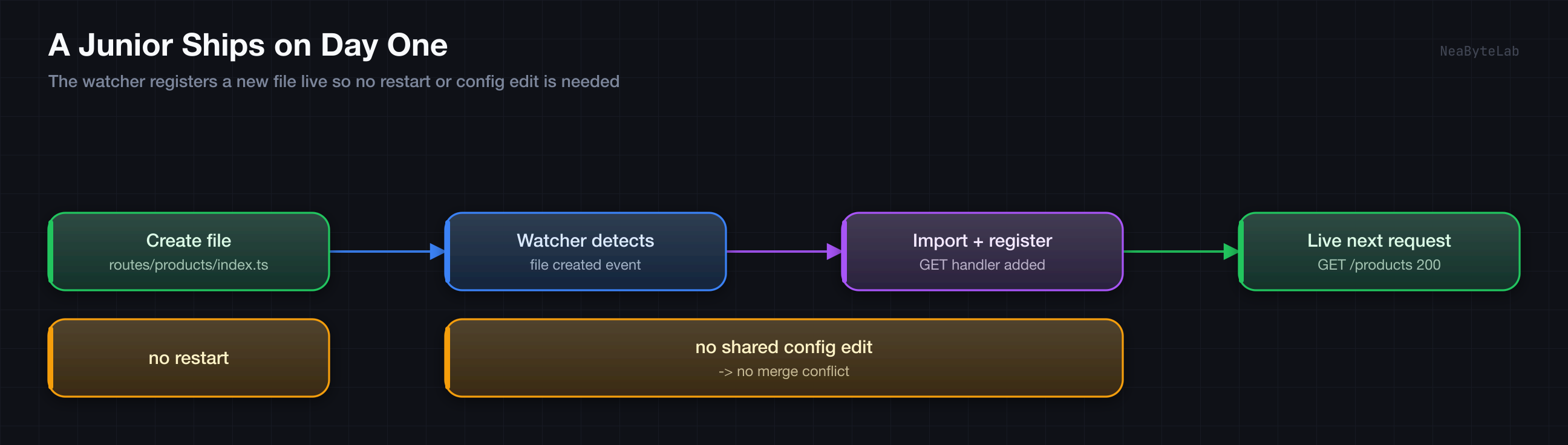
Adding an endpoint means adding a file. A junior developer who needs a GET /products route creates routes/products/index.ts and exports a handler:
// routes/products/index.ts
import type { Context } from '@neabyte/deserve'

// New endpoint, no registration needed
export function GET(ctx: Context): Response {
  return ctx.send.json({
    products: []
  })
}
The route is live on the next save through Hot Reload, with no restart and no edit to a shared config file that might cause a merge conflict.
Predictable Handlers
Every route file follows the same shape, so reviewing a teammate's code needs no guesswork. The exported function name is the HTTP method, and the Context gives the request and the response helpers:
// routes/orders/index.ts
import type { Context } from '@neabyte/deserve'

// Method name is the HTTP verb
export async function POST(ctx: Context): Promise<Response> {
  // Read parsed JSON body
  const order = await ctx.get.body()
  return ctx.send.json(
    {
      created: true,
      order
    },
    { status: 201 }
  )
}
A reviewer reads POST and knows the verb, reads ctx.get.body() and knows the input, reads ctx.send.json() and knows the output. The same pattern holds across every file, which is the developer experience the framework aims for. Details live in Request Handling and the Context Object.
Shared Rules in One Place
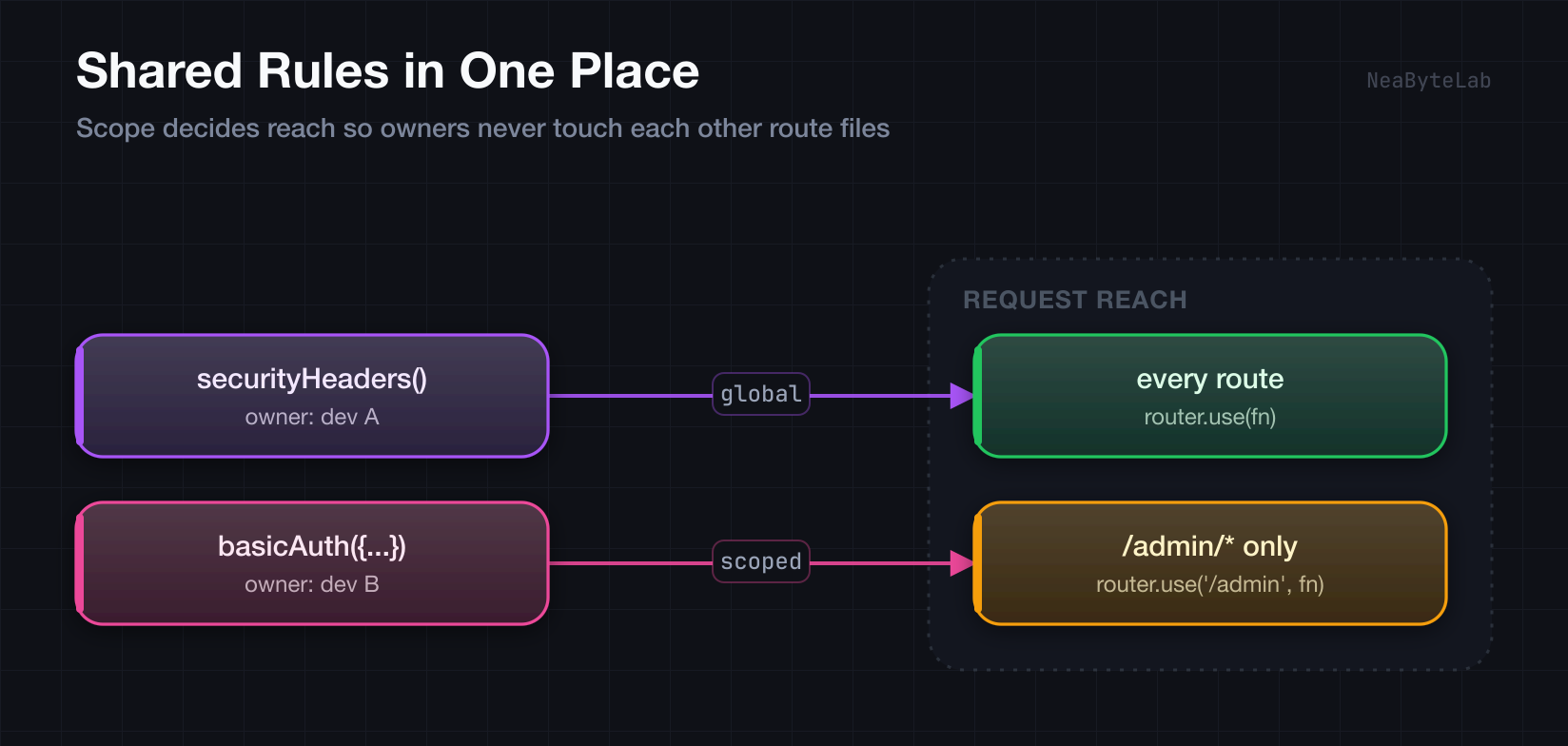
Cross-cutting concerns stay in one spot rather than scattered through handlers. One developer can own auth, another can own logging, and neither has to touch the other's route files:
// main.ts
import { Mware, Router } from '@neabyte/deserve'

const router = new Router()

// Security headers for every route
router.use(Mware.securityHeaders())

// Auth only for the admin area
router.use(
  '/admin',
  Mware.basicAuth({
    users: [
      {
        username: 'admin',
        password: Deno.env.get('ADMIN_PASSWORD') ?? 'change-me'
      }
    ]
  })
)

await router.serve(8000)
Handlers stay focused on their own job, while shared behavior is applied once. The full set of building blocks is in Global Middleware, and errors flow to one place through error handling. Input rules belong here too, where a validation contract checks a request before the handler so each route reads only data that already passed.
Many Hands, One Process
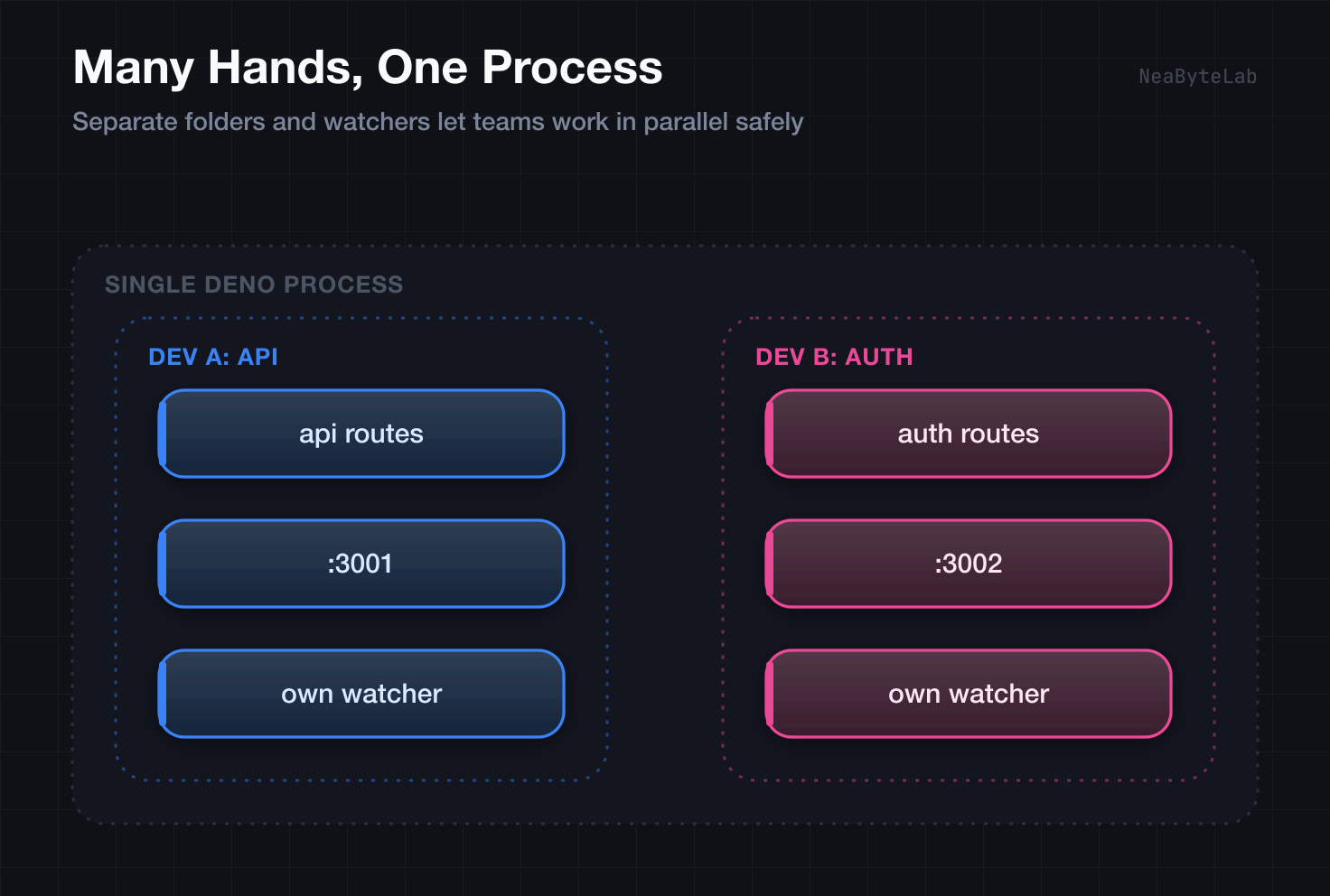
Larger teams often split an app into services. Deserve runs several routers in a single process, so one person can work on the API while another works on auth without separate deployments or network glue between them:
// main.ts
import { Router } from '@neabyte/deserve'

const api = new Router({
  routes: { directory: './services/api/routes' }
})
const auth = new Router({
  routes: { directory: './services/auth/routes' }
})

// Each service owns its folder and port
await Promise.all([
  api.serve(3001),
  auth.serve(3002)
])
Each service has its own folder, port, and file watcher, so teams move in parallel without stepping on each other. The full pattern, including shared code and a shared error handler, is in Multi-Service.
Where to Go Next
- File-based Routing - how folders map to URLs
- Hot Reload - edits go live without a restart
- Multi-Service - many services in one process
- Philosophy - the thinking behind the design