
Error Reporting
Errors surface on the same router.on() bus, so reporting lives in one listener rather than spread across handlers.
Reporting Failed Requests
request:failed fires whenever a response status is 400 or higher, and carries the original error when one exists:
import { Router } from '@neabyte/deserve'

const router = new Router({
  routes: { directory: './routes' }
})

// Record every failed request
router.on((event) => {
  if (event.kind === 'request:failed') {
    const { method, url, statusCode, error } = event.metadata as {
      method: string
      url: string
      statusCode: number
      error?: Error
    }
    console.error(`${method} ${url} ${statusCode}`, error?.message)
  }
})

await router.serve(8000)
Capturing Process Faults
process:failed fires for unhandled rejections, uncaught errors, and blocked termination attempts. A serving router keeps running and reports the fault instead of crashing:
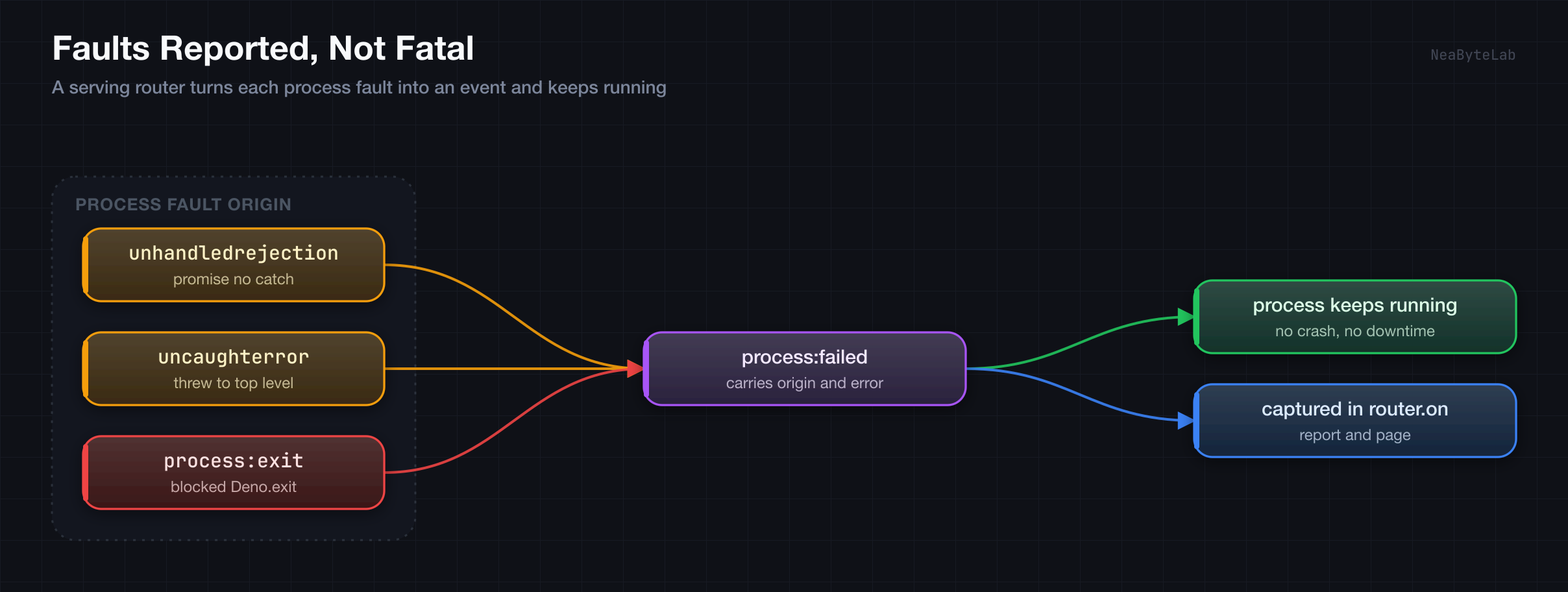
router.on((event) => {
  if (event.kind === 'process:failed') {
    const { origin, error } = event.metadata as { origin: string; error: Error }
    // origin tells the fault source
    console.error(`process fault [${origin}]`, error.message)
  }
})
Capturing Subsystem Faults
The same listener catches faults from the worker pool and the built-in middleware. A task that times out, a worker that crashes, a dispatch refused under load, a session cookie that fails to decode, and a CSRF rule that throws each arrive as their own event. Filter on the kinds listed under Workers and Security Middleware to route them wherever logs go:
router.on((event) => {
  // React to worker and middleware faults
  if (event.kind === 'worker:crashed' || event.kind === 'session:invalid') {
    console.error(event.kind, event.metadata)
  }
})
Pairing With Error Handling
Shaping a response and recording a failure are separate jobs. router.catch() controls what the client sees, while router.on() records what happened for logs and metrics. The two run independently, and wiring both is covered in Defense in Depth.