
Defense in Depth
Errors in Deserve pass through several layers, and each layer is a chance to catch, shape, or record a failure. When one layer lets an error through, the next one still holds, so the server keeps responding and never crashes.
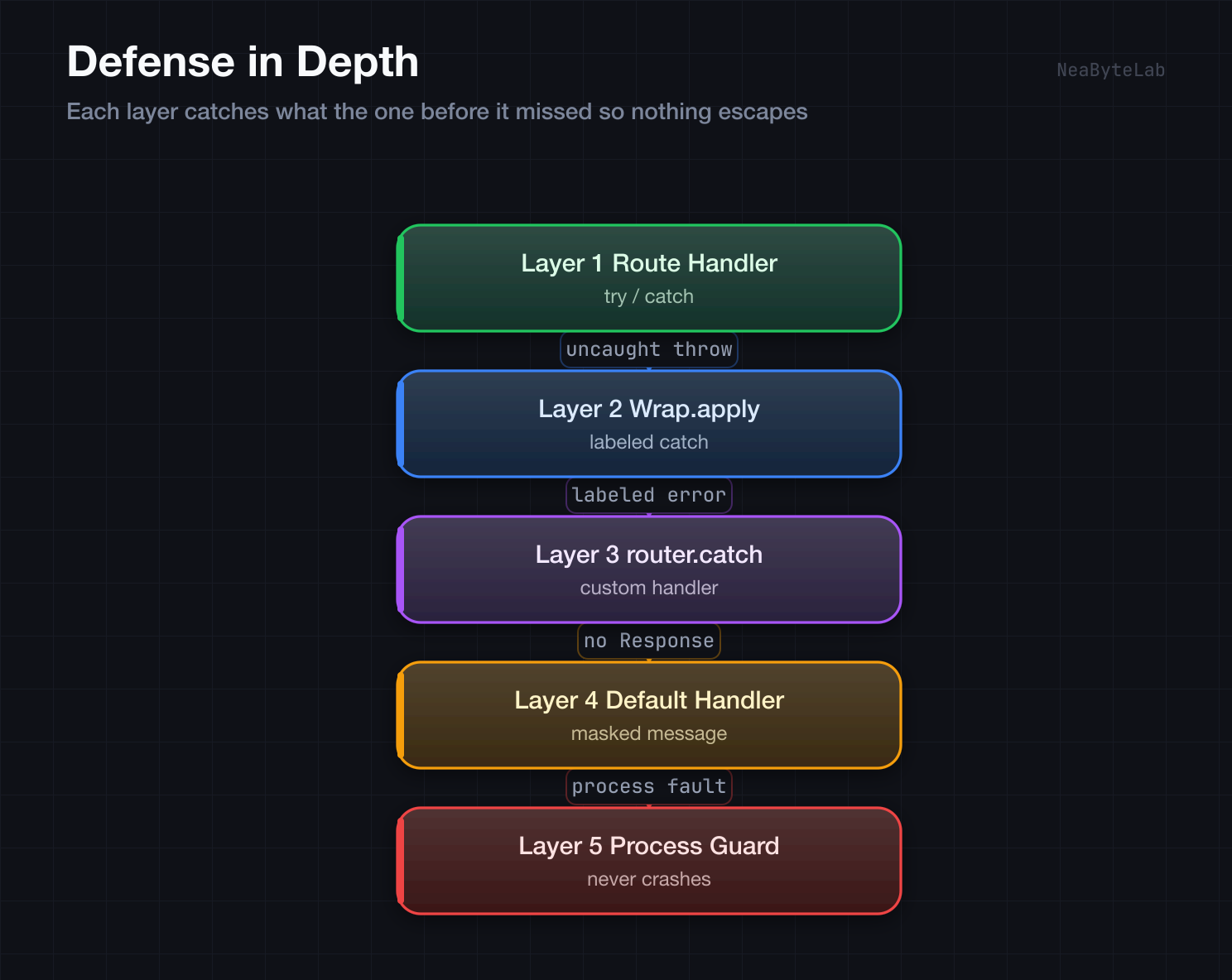
Layer 1 - Route Handler
The closest layer is the handler itself. A local try/catch turns an expected failure into a precise response:
export async function POST(ctx: Context): Promise<Response> {
  try {
    const data = await ctx.get.body()
    return ctx.send.json({
      success: true
    })
  } catch (error) {
    // Handle the expected failure here
    return ctx.send.json(
      {
        error: 'Invalid body'
      },
      {
        status: 400
      }
    )
  }
}
Anything thrown past this point falls to the next layer.
Layer 2 - Labeled Middleware
Wrap.apply wraps a middleware so a throw becomes a labeled error routed to the error handler. The label points straight at the failing middleware:
// Throws here reach router.catch with a label
const auth = Wrap.apply('Auth', async (ctx, next) => {
  if (!ctx.get.header('authorization')) {
    throw new Error('Missing token')
  }
  return await next()
})

router.use(auth)
See Global Middleware for the full pattern.
Layer 3 - Custom Error Handler
router.catch() receives every uncaught error and shapes the client response. It runs for handler errors, middleware errors, not-found, and static file errors alike:
router.catch((ctx, error) => {
  // Shape one response for all errors
  return ctx.send.json(
    {
      error: 'Something went wrong'
    },
    {
      status: error.statusCode as HttpStatusCode
    }
  )
})
The handler receives an error object with statusCode, pathname, url, method, and the original error. See Object Details for each field.
Layer 4 - Default Handler
When no router.catch() is set, or the custom handler returns something other than a Response, Deserve falls back to the default handler. It negotiates JSON or HTML by the Accept header and masks the original message, so a thrown error never leaks its text to the client:
// Client gets a safe, status-based message
// 500 -> "Internal Server Error"
// 404 -> "Not Found"
When the security headers middleware runs before the fault, its headers stay on the error response too. See Default Behavior for the full response shape.
Layer 5 - Process Guard
The outermost layer runs process-wide. A serving router traps unhandled rejections, uncaught errors, and blocked termination attempts, then reports each as a process:failed event instead of letting the process die:
router.on((event) => {
  if (event.kind === 'process:failed') {
    const { origin, error } = event.metadata as { origin: string; error: Error }
    console.error(`process fault [${origin}]`, error.message)
  }
})
This is the safety net behind everything else. See Process Protection for what it blocks and why, and Error Reporting for how to capture these.
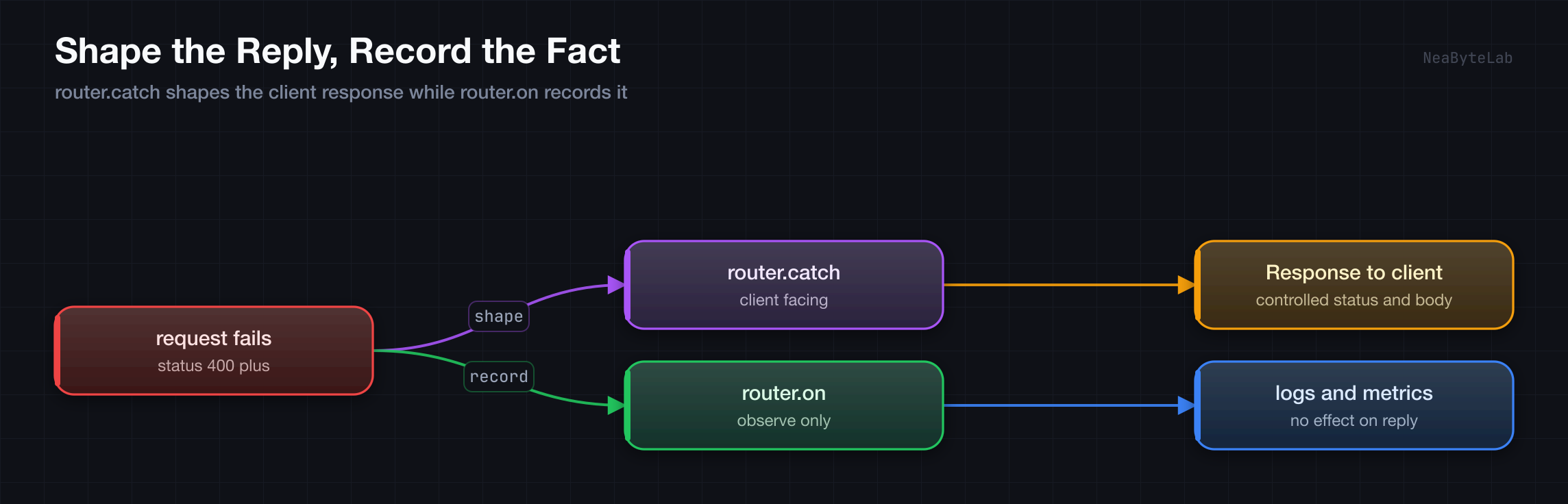
Recording Across Layers
Shaping a response and recording a failure are separate jobs. router.catch() controls what the client sees, while router.on() records what happened for logs and metrics. Wire both for full coverage:
// Shape the client response
router.catch((ctx, info) => {
  return ctx.send.json(
    {
      error: 'Something went wrong'
    },
    {
      status: info.statusCode as HttpStatusCode
    }
  )
})

// Record the failure for later
router.on((event) => {
  if (event.kind === 'request:failed') {
    const { url, error } = event.metadata as { url: string; error?: Error }
    console.error(url, error?.message)
  }
})