
Validator Middleware
Validator.check(schema) turns a schema into middleware. It reads each source named in the schema, runs the matching contract, and stores the result on the context for the handler to read.
Registering The Middleware
Pass the middleware to router.use, the same call that registers every other middleware:
import { Router, Validator } from '@neabyte/deserve'

const router = new Router({
  routes: { directory: './routes' }
})

const createUser = {
  body: Validator.define((body: { name: string }) => ({ name: body.name.trim() }))
}

// Run for every request
router.use(Validator.check(createUser))

await router.serve(8000)
Scoping To A Route
A path prefix limits the validator to matching routes, which follows the rules in Route-Specific Middleware:
// Validate only under /users
router.use('/users', Validator.check(createUser))
For global versus scoped registration in general, see Global Middleware.
Validating Several Sources
A schema can name more than one source, and each contract validates its own slice of the request:
const listUsers = {
  // Page number from the query string
  query: Validator.define(
    (q: Record<string, string>) => ({ page: Number(q['page'] ?? '1') }),
    (q) => (/^\d*$/.test(q['page'] ?? '') ? true : 'page must be numeric')
  ),
  // API key from the request headers
  headers: Validator.define(
    (h: Record<string, string>) => ({ apiKey: h['x-api-key'] ?? '' }),
    (h) => (h['x-api-key'] ? true : 'x-api-key header is required')
  )
}

// Validate query and headers together
router.use('/users', Validator.check(listUsers))
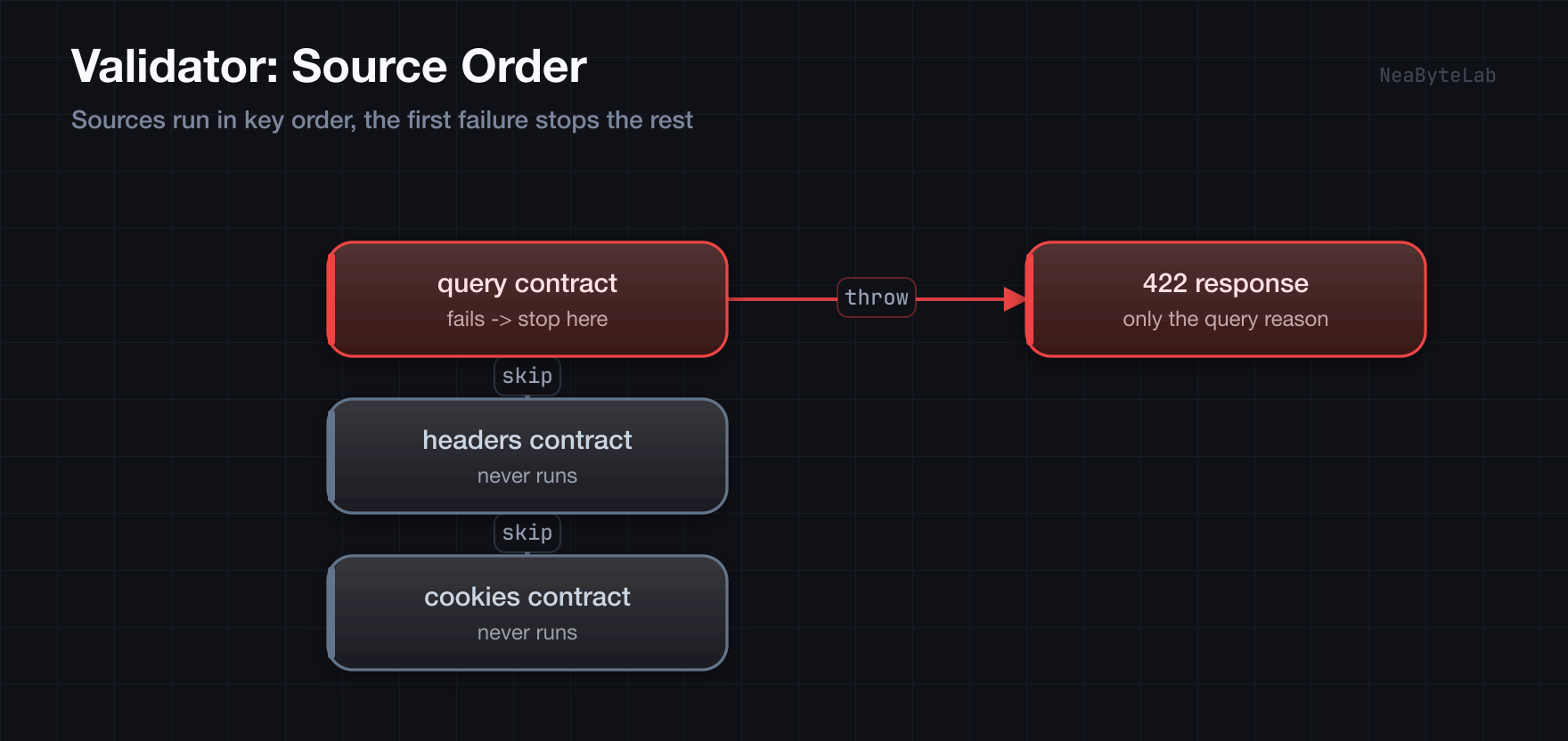
Several sources validate in the order their keys appear, and the first failing source stops the rest. That order rule lives in Advanced Patterns.
One Schema Per Route
Each validator stores its own result on the context, and a later validator replaces the stored value rather than merging into it. Registering two validators on the same route leaves only the last one readable, so several sources belong in a single schema:
// Combine sources in one schema
const userRules = {
  query: Validator.define((q: Record<string, string>) => ({ page: Number(q['page'] ?? '1') })),
  body: Validator.define((body: { name: string }) => ({ name: body.name.trim() }))
}

// One validator carries both sources
router.use('/users', Validator.check(userRules))
The handler reads query and body together in one call through ctx.get.validated(), shown in Reading Validated Data.
Unsupported Sources Are Rejected
A schema that names a source other than body, cookies, headers, or query throws Deno.errors.InvalidData at registration. Route params resolve after middleware runs, so the middleware would only ever see an empty object. Validate params inside the handler with a direct contract call instead, covered in Reading Validated Data.
An Empty Schema Is Rejected
A schema with no source contract also throws Deno.errors.InvalidData at registration, since a validator with nothing to validate is a wiring mistake worth catching early:
import { Validator } from '@neabyte/deserve'

// Throws InvalidData, no sources given
Validator.check({})
Both rejections fire when the server starts, not on a request, so a broken schema never reaches production traffic.
Where To Go Next
- Reading Validated Data - read the stored output in a handler
- Define Schema - shape the contracts a schema points to
- Advanced Patterns - pick a schema per method on a shared prefix
- Validation Overview - how the pieces fit together