
Event Reference
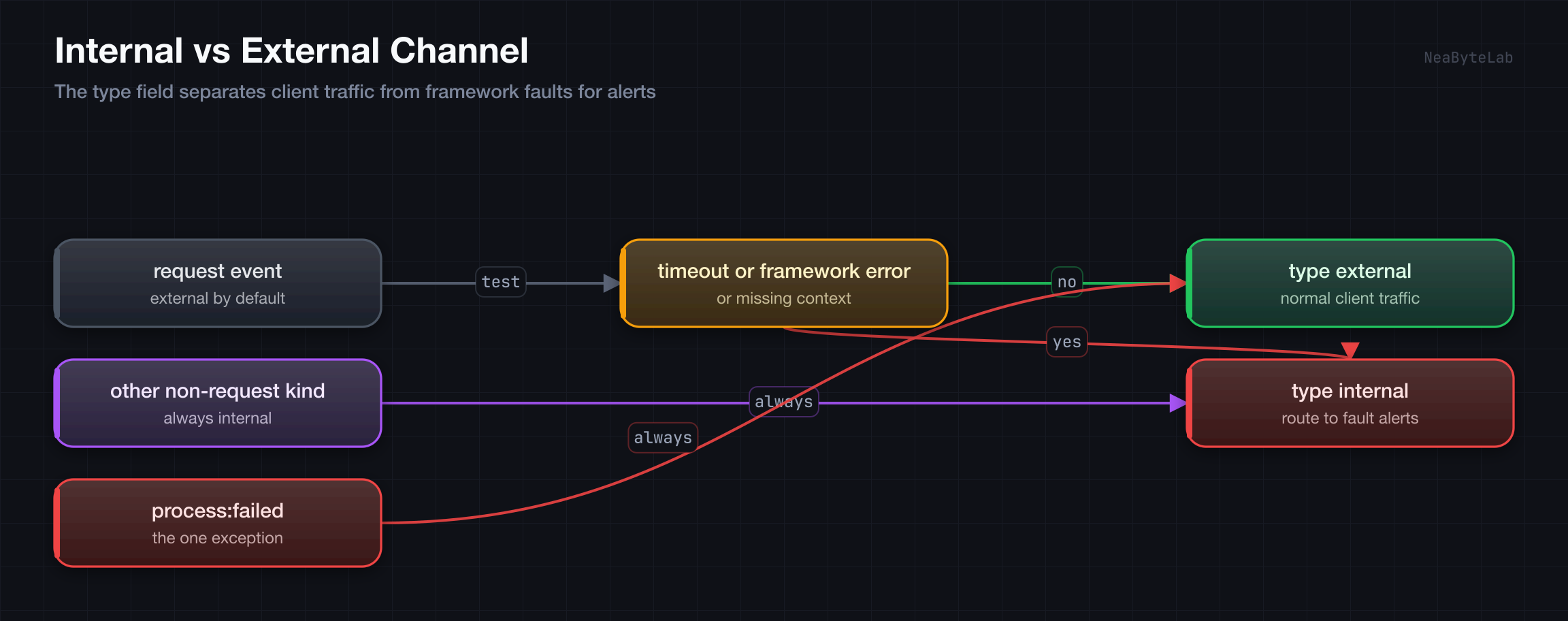
Every event from router.on() carries a kind discriminant and a metadata object. This page lists each kind and the fields it provides.
Server
| Kind | Metadata |
|---|---|
server:started | port, hostname |
server:stopped | none |
server:started fires once the server binds. server:stopped fires after the server stops draining.
Routes
| Kind | Metadata |
|---|---|
route:added | path, pattern |
route:updated | path, pattern |
route:removed | path, pattern |
route:ignored | path, reason |
route:failed | path, error |
route:added fires when a route file loads, route:updated when hot reload picks up a change, and route:removed when a file disappears. route:ignored names a file that was skipped and why, while route:failed carries the error when a route fails to load.
Views
| Kind | Metadata |
|---|---|
view:compiled | path, durationMs |
view:rendered | path, durationMs |
view:invalidated | paths |
view:failed | path, error |
View events come from the DVE rendering engine. view:invalidated fires when a template change clears cached output, carrying every affected path.
Workers
| Kind | Metadata |
|---|---|
worker:timeout | index, timeoutMs, error |
worker:crashed | index, error |
worker:respawned | index |
worker:rejected | reason (queue-depth, queue-wait), queueDepth, maxQueueDepth |
worker:timeout fires when a task passes its deadline, worker:crashed when a worker dies mid-task, and worker:respawned when the freed slot is replaced. worker:rejected fires when a dispatch is turned away under load, with reason saying whether the queue depth or the projected wait tripped the limit. These come from the worker pool.
Security Middleware
| Kind | Metadata |
|---|---|
session:invalid | cookieName, reason (tampered, expired, malformed) |
csrf:failed | rule (origin, secFetchSite), error |
cors:blocked | origin |
auth:failed | reason (missing, malformed, invalid) |
ip:denied | ip |
validate:failed | source (body, cookies, headers, query), reasons |
body:rejected | limit, declared |
websocket:rejected | reason (origin, version, malformed) |
static:missing | path |
Each security event pairs with its middleware and fires the moment the check refuses a request:
session:invalidfires when a signed cookie fails to decode, withreasonnaming a tampered value, one aged pastmaxAge, or a malformed one, while the request continues with no session attached. It comes from the session middleware.csrf:failedfires when a CSRF rule throws, naming which rule broke while the check still falls safe to a refusal. It comes from the CSRF middleware.cors:blockedfires when an origin is refused, carrying that origin. It comes from the CORS middleware.auth:failedfires on a rejected login, withreasonnaming a missing header, a malformed one, or wrong credentials. It comes from the basic auth middleware.ip:deniedfires when an address is blocked, carrying the denied IP. It comes from the IP restriction middleware.validate:failedfires when a contract rejects input, naming thesourceand thereasons. It comes from validation.body:rejectedfires when a declared body exceeds the cap, carrying thelimitand thedeclaredsize. It comes from the body limit middleware.websocket:rejectedfires on a refused handshake, withreasonnaming a bad origin, a version mismatch, or a malformed upgrade. It comes from the WebSocket middleware.static:missingfires when a static path resolves to no file, carrying that path.
Requests
| Kind | Metadata |
|---|---|
request:completed | method, statusCode, url, durationMs, metrics |
request:failed | same as request:completed, plus an optional error |
request:completed fires for every finished request. request:failed fires in addition whenever the status is 400 or higher, and carries error only when a framework error produced the failure. Both carry optional OpenTelemetry-aligned metrics when known: route, serverAddress, serverPort, userAgent, requestSize, responseSize, and ip.
Turn these into a log in Request Logging.
Process
| Kind | Metadata |
|---|---|
process:failed | error, origin (unhandledrejection, uncaughterror, process:exit, process:signal) |
A serving router traps unhandled rejections, uncaught errors, and attempts to terminate the process. Each fault becomes a process:failed event rather than crashing the server, so a single failure never takes the process down. A blocked termination call carries origin: 'process:exit' and names the call, for example Blocked Deno.exit(0) process termination is not permitted from application code. See Process Protection for the reasoning, and capture these in Error Reporting.